Field notes
A Healthy-Home Checklist Before Design Is Final
Plan moisture control, ventilation, materials and verification early. A practical checklist for homeowners designing a new house or major renovation.
By Alik Konovalenko · · 5 min read
Updated
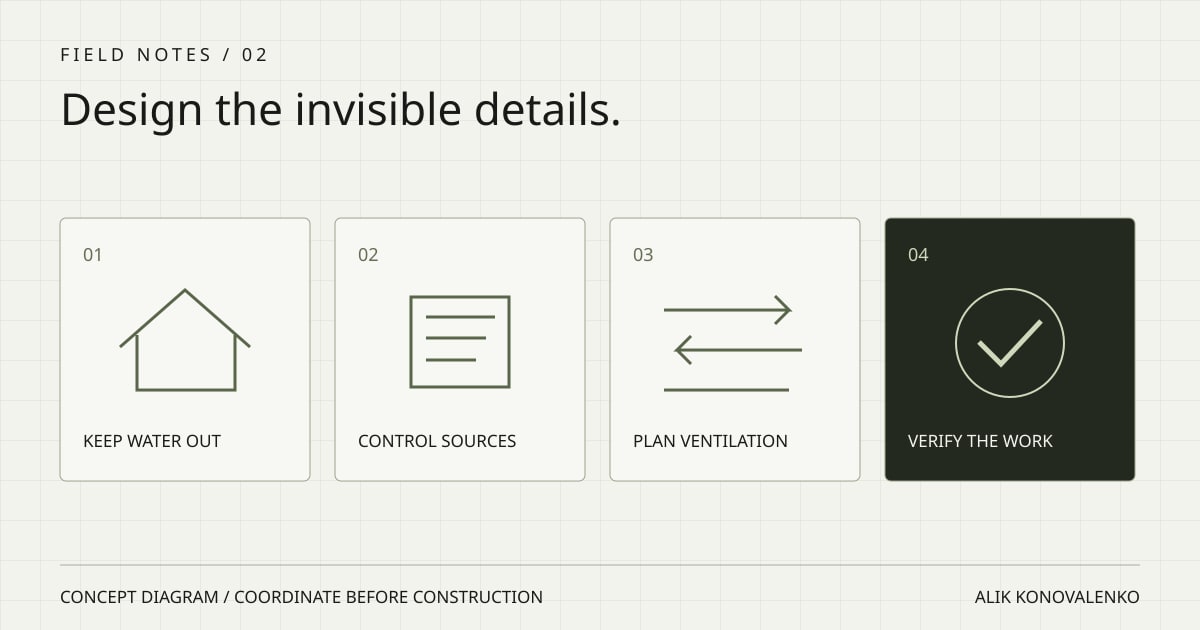
For a healthier home, start with the building decisions: moisture control, sources of indoor pollutants, ventilation and a plan to verify the finished work. Put them in the design brief before the drawings are final, then give each decision an owner.
A product list is useful only when it fits a complete plan. A filter needs a system that can accommodate it. A bathroom exhaust fan needs a route outdoors. Waterproofing needs coordinated details at the places where materials meet.
Make the brief specific
Write down how the home will be used, what the occupants want to prioritize and which existing conditions need investigation. For a renovation, include known leaks, odors, condensation or previous repairs. Share relevant sensitivities with the appropriate health professional; a construction plan does not diagnose symptoms.
EPA’s Indoor AirPlus program is a useful reference for the design discussion. Its construction specifications cover moisture, HVAC, combustion venting, radon-resistant construction and low-emitting materials. It is a voluntary certification program. Using its topics as a checklist does not make a home certified; any certification must be separately specified and verified.
1. Give water a continuous path away
Ask the design team to explain the water-management approach from roof to foundation. Review the junctions: windows, doors, roof penetrations, balconies, showers and walls adjoining the ground.
Create a short inspection plan for details that will disappear behind finishes. Identify who reviews each detail, when it can be inspected and what photographs or records should be kept. Coordinate the sequence with the builder so another trade does not cover the work first.
For an existing house, hidden-mold warning signs are a reason to investigate the moisture source before improving the finish. On a hillside, the site due-diligence checklist helps organize the larger drainage questions.
2. Control sources before adding devices
EPA’s remodeling guidance puts source control, ventilation and air cleaning together. It recommends addressing pollution from new materials and from disturbing existing materials during the work.
In practical terms, ask for a material schedule before purchasing. Record the exact product, intended use, relevant emissions documentation and any proposed substitution. Review adhesives, sealants and coatings as well as the visible flooring or cabinetry. “Green” is too broad to tell the purchasing team what to buy.
For renovation work, ask the project team what needs assessment before demolition. A clean-looking surface does not establish what is underneath it. Testing and specialist work, where needed, should be defined before it becomes a surprise during construction.
3. Design ventilation with the rooms
Discuss ventilation while equipment locations and routes can still be changed. Ask the mechanical designer how outdoor air, kitchen and bathroom exhaust, filtration and controls will work together.
The useful questions are concrete: where does air enter, where does exhaust leave, how will filters be reached, and who will check the installed performance? EPA notes that mechanical ventilation complements source control; air cleaning is an additional strategy, not a substitute for the first two.
If you’re building a tightly sealed new home, use these seven questions about fresh air and ventilation with your builder. Include operation and maintenance in the discussion. A homeowner should leave handover knowing which controls to use and which components need regular attention.
4. Decide how the result will be verified
Before construction starts, list the checks, responsible people and records required at handover. Discuss water-management inspections, mechanical-system testing and a record of the products actually installed. An equipment label alone does not describe how the completed system performs.
Include radon in the conversation where appropriate. EPA recommends testing newly built homes, including those with radon-resistant features. Ask the relevant professional to determine the project’s approach and the testing plan.
The one-page meeting checklist
- Brief: priorities and existing conditions recorded.
- Water: roof, openings, wet rooms and foundation details coordinated.
- Materials: exact products and substitution review agreed.
- Air: ventilation, exhaust, filtration and service access planned.
- Verification: checks, timing and responsible people named.
- Handover: results, manuals and a maintenance schedule collected.
For every line, ask: Who owns it, what document defines it, and how will we know it was done? Those three questions turn a good intention into a construction task.
My construction advisory sessions offer a builder’s perspective on these decisions and their sequence. Design, engineering, environmental testing and medical advice belong with the respective qualified professionals. The aim is a coordinated home, with decisions made early enough to carry through to the finished work.